









The radical reinvention of Cameron McEvoy
It seemed like the swimmer’s career was over after failing to make it out of the heats at the Tokyo Olympics in 2021. Five years on, he’s won everything there is to win courtesy of a revolutionary new training philosophy, proving that sometimes the best way forward is to stop doing what everyone else is doing
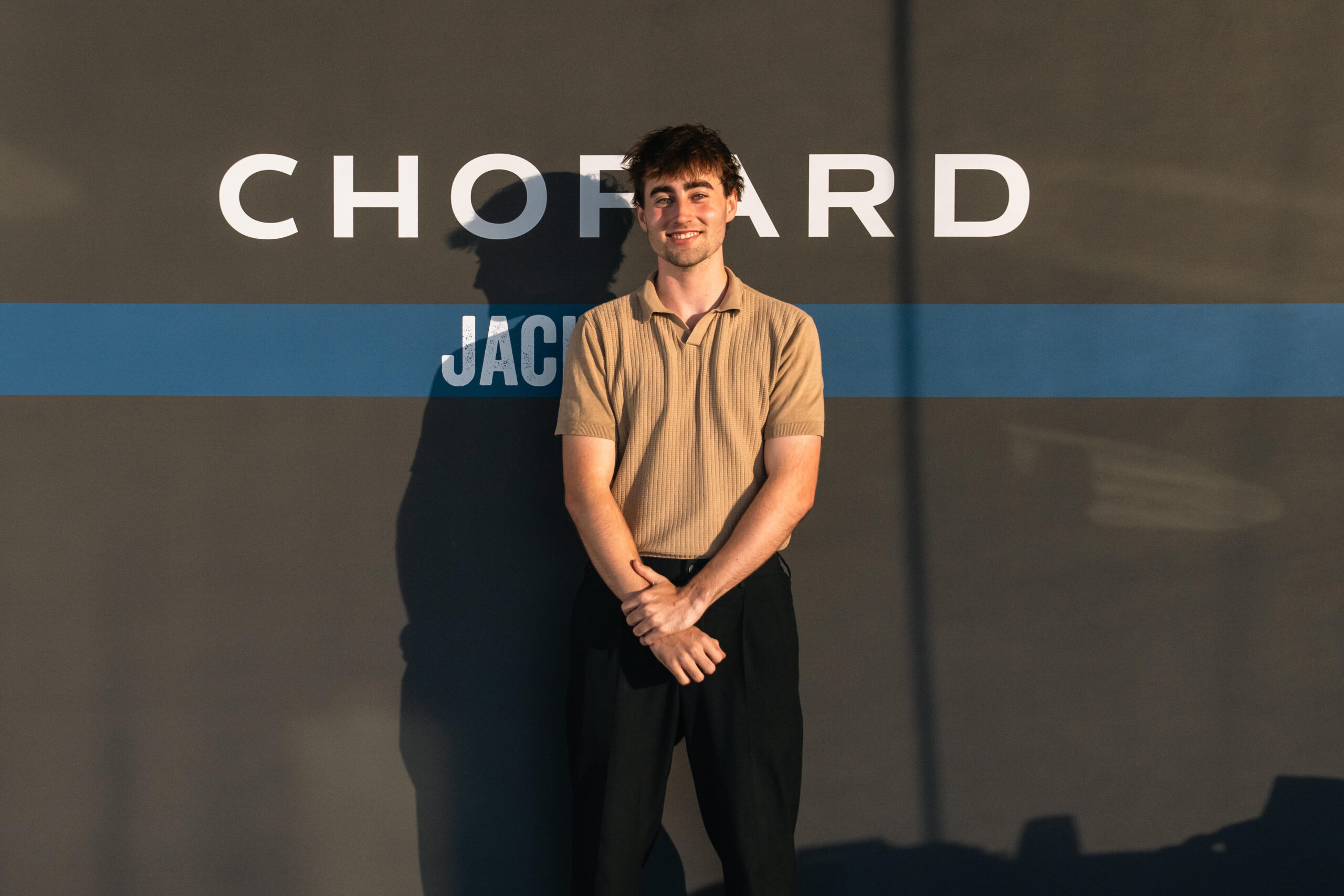 By Cayle Reid
BEFORE HE WAS an Olympic gold medallist, before he was a double world champion, before he was a world record holder, the fastest swimmer ever over 50 metres – before any of that – Cameron McEvoy was simply relieved to have made it onto the plane for the Tokyo Olympics.
It was the Northern summer of 2021. Most of the world was in lockdown. Australia’s Olympic swim team had just finished the ‘COVID Olympics’ with a haul that remains the best in the country’s history. McEvoy, then 27, had picked up his third Olympic medal by swimming in the heats for the 4×100-metre freestyle relay team that would go on to take bronze. On an individual level, though, it was an uninspiring campaign.

He was bounced in the heats of both the 50-m and 100-m freestyle, finishing 29th and 24th overall, respectively. He wasn’t disappointed, though. Taking to Instagram after the Games, he shared a slideshow of photos taken with his teammates, medals around their necks. “This time last year I had effectively unofficially quit,” he wrote in the caption. “I prepared the best I could off only half a season’s work and earned my spot on the greatest Olympic swim team in the history of our nation.”
It reads like the beginning of retirement speech, as though McEvoy figured it could be the end of the road. It also reads like a man making a concession – I’m happy just to be here, regardless of the results, and I didn’t have much time to prep anyway!
Reading it now, it makes you wonder how everything could have changed so drastically. When I ask McEvoy about that period five years on, during a Friday afternoon call to his home in Brisbane, he doesn’t dress up the memory. “I didn’t know if I was going to come back to swimming,” he says. “I didn’t know if, even if I did choose to come back, that there would be an opportunity for me.”

Naturally, nobody watching him finish 29th assumed they were witnessing a sleeping giant about to stir. McEvoy had put in a decent innings – eight Commonwealth Games gold medals, six World Championship medals and three Olympic medals – but he was 27, after all. In any other sport, you still have plenty of juice left at 27. Not in swimming. At the Tokyo Olympics, the average age of men’s gold medallists in the 50-m freestyle was 23.9, and only one person had won gold on the wrong side of 30 – the American Anthony Ervin, who, considering he did it at age 35, seemed like a bit of an outlier. McEvoy himself once told the ABC: “You’re 24 in swimming and they’re handing you your pension”.
It looked like McEvoy’s Olympic career would end without a gold medal. By the time Tokyo wrapped up, he had already come to terms with that outcome and decided to take a step back from swimming for a few months. But once he allowed a decade of half-formed doubts about his own training methods to breathe, everything changed. A few years later he was standing on top of an Olympic podium as the second-oldest man ever to win his event.
How did he get there? McEvoy will explain it to you in a matter of fact, analytical way. He has degrees in physics and mathematics and has spent the last half-decade treating his body like an experiment. The longer I talk to him, the clearer it becomes that his brain simply operates differently to everyone else’s. Where many athletes operate on feel, repetition and practice, McEvoy calculates outcomes and aims for percentiles. Where most careers end in a graceful surrender to age or misfortune, McEvoy has stubbornly persisted and proven Dara Torres’ adage that the water doesn’t know how old you are. And after decades spent doing what everyone else said he was supposed to, it turned out that the best thing for McEvoy was to stop listening.

WHEN I SPEAK with McEvoy, it’s not long after he’s wrapped up training for the day. I ask him how much distance he swam, and he says he’s not really sure. That tells you everything you need to know. “I don’t track how far I go anymore,” he says. “For a lot of my reps, I do a 15- or 20-metre rep, with or without resistance attached. Sometimes I don’t even hit the wall at the other end of the pool.”
He used to know exactly how far he swam. Down to the decimal point. For most of his career, swimming was an exercise in accumulation. It was all about spending as much time in the water as possible. He remembers the prevailing philosophy as, essentially: If training doesn’t hurt, then you’re not making progress. At peak volume, he was swimming 40 kilometres a week. Now, he estimates that he does around one and a half.

He didn’t arrive at this system out of the blue. “For a long time, I had the idea that my training was not right for my events,” he says. “I had been thinking about that for nearly a decade before Tokyo, But I’d never really had the opportunity to sit down and flesh it out.”
While he was satisfied with simply making it to the Tokyo Olympics, the experience also helped him realise he must be doing something wrong. “I was pretty un-optimised with how my body was moving,” he explains. “I was doing all of the high-volume stuff, doing so many kilometres for such a long period of time. I had lost a lot of mobility. My strength training and gym work were basically non-existent at the time because I just couldn’t fit it in around the volume of swimming that I had to do.”
Unsure of whether he wanted to retire after Tokyo or return to his usual routine and give it another crack, he decided to take a break. He spent the next three months “doing nothing”, because he needed a mental break as much as a physical one. “That was really the first time I had had a break in 18 years,” he says. “I was mentally really burnt out and swimming worse than I ever had, despite training better than I ever had.”
In those three months, McEvoy started rock climbing. For fun. He had no idea what would come of it. “I was just doing it as a hobby,” he says, “but I realised that some of the guys I was training with had a strength-to-weight ratio that no one in swimming could come close to. I started thinking about what a swimmer could do if they had that level of strength. What would they look like in the water? Would that make them faster? Or would it hinder their performance?”
Then he turned to gymnastics, then calisthenics, absorbing training philosophies that had nothing directly to do with swimming. Then he turned to track and field and found, again, an entirely different set of underlying rules. “The general axioms that they use to make progress are significantly different to anything that I’d come across in swimming. And the more I learned about that, the more I started to question what it could look like if I were to recontextualise these philosophies for swimming.”
He started writing it all down. “This was all an unknown in the swimming world,” he says, “but they’d been doing this stuff in track for 30 years, in strength training for 50 years.” At some point, sitting with a year’s worth of notes, he had his moment of clarity. “At that point I figured I just had to give it a go.” What did he have to lose?
What came out the other end is a training program that, as far as he knows, has no precedent in competitive swimming. He’s rewritten the volume-based training playbook and replaced it with a heavier emphasis on highly specialised reps, strength training and data collection. The results exceeded even the most ambitious expectations.

MCEVOY WAS A PRODIGY. He made his Olympic debut at the age of 18, as one of the youngest members of the Australian team. It was a surreal but slightly daunting experience. “I’ve always been a swimming nerd, so I grew up watching my idols on TV and then, suddenly, I was seeing them in person,” he says. “Guys like Ryan Lochte, Michael Phelps – I’d watched them for so long and all of a sudden I’m racing them.”
Rio 2016 was supposed to be his breakthrough. Three months earlier he set a new Australian record in the 100-m freestyle, and he entered the Games as the gold medal favourite. It didn’t go his way, and he doesn’t mince words when reflecting on it. “I was shattered,” he says. “I knew 30 metres out from the wall that things weren’t going to go well, and it was the absolute worst feeling. The only way to describe the feeling is broken. It took me years to get over that.” If there was a silver lining, it was that McEvoy’s compatriot, the 18-year-old Kyle Chalmers, did win gold. “If someone had to win it, I wanted it to be an Australian,” McEvoy says.
In keeping with what he’d been taught, his solution was to train harder. “My natural response was to try and bounce back as quick as possible, so I went straight back into training,” he says. “I tried to take on the advice of the people around me and basically doubled the amount of effort I was putting in. In hindsight, I can see how that made me worse.”
It was around the same time that he was completing a science degree at Griffith University, majoring in physics and mathematics – which is why other Australian swimmers call him ‘The Professor’. He was doing an honours program before he decided to focus on swimming full-time again to test his new training methods. His thesis is difficult to describe in layman’s terms. Here’s a sample of what he told me:
“It was on Roger Penrose’s orchestrated objective reduction, which is basically his theory that quantum gravity is linked to consciousness. I still follow how he’s progressed with that. It’s all very fascinating.”
Is there an overlap between quantum gravity and swimming? Not so much. But McEvoy does believe his scientific background was useful in exploring his training theories. “The biggest tool that I got out of that was the ability for problem-solving and the ability to go into one field, take some information and apply it to a completely different field by seeing the overlap between the two,” he says.
McEvoy has been his own guinea pig while developing his training system (a bit like if Victor Frankenstein experimented on himself instead of his monster), and his background meant he wasn’t new to experimentation. “For a lot of the stuff I do now, I had to test it myself because it hadn’t been done before,” he says. “Questions like, What’s the optimal resistance to use during training? What velocity do you want to be hitting and what rep ranges and distances? Is it more effective to be swimming with a belt and 200 kilos of resistance, or just with bodyweight?”
After forgoing the 2022 Commonwealth Games to refine his new training strategy, McEvoy’s first opportunity to put it to the test was the 2023 world championships in Fukuoka, where he won gold in the 50m freestyle just two years after flaming out in the heats at the Olympics. The result was even better than he expected, and it forced him to change his plans. “The idea initially was to start with the 50 and get my speed as good as I could and then transition back to the 100 with a better speed reserve,” he says. “But I went so well at the 2023 world championships that I thought I should stick with it. I was thinking, This isn’t even fully optimised and I’m only 0.5 off the world record.”
The stage was set for the 2024 Paris Olympics. But just a few months out, McEvoy had to settle for silver at the 2024 world championships in Doha. By his own assessment, he swam below his capabilities. For all its merits, his new method didn’t make him invincible. He went into Paris with nerves threatening to overwhelm him. “With my own personal history at the Olympics, I didn’t have a good relationship with them, so I was really nervous going in,” he says. “I know what it’s like to go into an event as the favourite and not win.”
This time, however, he did win. He claimed his first Olympic gold medal at the age of 30, becoming the second- oldest winner in the event in one of sport’s greatest redemption arcs.
McEvoy believes that his method actually works to control nerves. Where one swimmer might focus on their personal-best time over the race distance, McEvoy is far more incremental. He prefers to look at the 50-metre freestyle not as a 20-second sprint but as a series of segments, and if he can complete each at just his median speed, that will compound into a performance that will almost guarantee him victory.
“I measure virtually every five-metre increment of every rep I do in training,” he explains. “By the time I got to the blocks in Paris, I’d done over a thousand reps. I knew that, if you were to plot all of my reps along a bell curve, if I were to get to the 35-metre mark at my 50th percentile, then I would have a really good shot to win gold. It’s not guaranteed, because other people can always swim in their 99th percentile, but I knew that if I could just swim in my 50th percentile I would have a really good chance at winning.”
One benchmark remained: the world record. Only two swimmers had ever recorded a time under 21 seconds in the 50-m freestyle, and both had done it in 2009, at the height of the super-suit era. McEvoy was unfazed by the technological disadvantage. In March of this year, he swam 20.88, a new world record. Redemption complete.
At the Commonwealth Games in July, McEvoy again went sub-21, becoming the only swimmer ever to do it twice. In what must be intimidating reading for any other 50-m freestylers, he doesn’t believe he’s swum a 99th-percentile race yet. “I was definitely much closer to that earlier this year when I got the world record. I wasn’t in the 99th, though,” he says. “There are still some levers to pull to get that little bit quicker.”
When I ask for his 99th-percentile time, McEvoy holds back. “If you take my best five-metre segment from every race I’ve done and combine them into one perfect race, you get an idealised time, but I’m going to keep that close to my chest.”

THE AUSTRALIAN SWIM team is now a curious mix of May and December. There are the usual youngsters trying to make their breakthrough, but there’s also an older crew that includes McEvoy and Chalmers, who are already past the point when most swimmers call it quits. McEvoy doesn’t see himself as much of an elder statesman, though.
“It [retirement] is definitely on my mind more than what it used to be now that I’ve started a family,” he says. “But right now as a swimmer I can make a living and still spend valuable time with my son, so I want to do that for as long as possible.”
The reality is that most swimmers are retired by their mid-twenties, not because swimming is somehow better suited to athletes who peak young, but because it’s not a financially viable career. Competing at the highest level requires a significant time and mental commitment (even if you’re using McEvoy’s efficient approach to training), so most swimmers don’t have the headspace to pursue a career outside of sport. At the same time, even the best athletes can struggle to attract sponsorship. You can imagine what it’s like for the ones who haven’t quite broken through.
“I’ve won pretty much everything since 2023. I have an Olympic gold medal, I’m a world record holder and I’ve won two world championships. And yet, sponsorships have been really hard to come by,” McEvoy laments. “Because of the nature of my event, I can be called the fastest swimmer in the world, and I still can’t get sponsors.”
That said, McEvoy is in no rush to retire while he can still make a decent living from swimming. But how long can he do it? There’s quite a distance between him and his closest competitors. But as he points out, the gap is closing. “Other athletes are adopting my method and seeing rapid results,” he says. “At the moment there’s a gap between me and everyone else, but there are some youngsters coming through who are closing the gap.”
Earlier this year, Russia’s Egor Kornev swam a 21.06, while Ukraine’s Nikita Sheremet swam a 21.13. Both times are faster than what McEvoy swam in the Olympic final to claim gold. But still, no one else has gone sub-21 without a super-suit. McEvoy believes that if he can stay around that level, he’ll be in contention at every major meet.
“I’ve been hovering around that 20.9 to 21-second mark for the last four years, and I think I can stay in that range for quite a while longer,” he says. “If I can hang around 21 seconds, I find it hard not to see myself getting at least a medal at every competition until Brisbane 2032.”
And who knows? Perhaps the secrets to swimming longevity are buried somewhere in the scientific literature. If they are, you can be confident McEvoy will be the first to dig them out.
Credits:
Words Cayle Reid
Photographer Jamie Green
Styling and Editor-in-Chief Grant Pearce
Production Rebecca Moore
Grooming Dyan Copeman
Related:
Why Brenton Thwaites is approaching life with a lighter touch


